
By clicking “Accept All Cookies”, you agree to the storing of cookies on your device to enhance site navigation, analyze site usage, and assist in our marketing efforts. View our Privacy Policy for more information.
“You cannot carry out fundamental change without a certain amount of madness. In this case, it comes from nonconformity, the courage to turn your back on the old formulas, the courage to invent the future. Besides, it took the madmen of yesterday for us to be able to act with extreme clarity today. I want to be one of those madmen.” — Thomas Sankara


When one peels away at everything, all the illusions of progress, of sanity, of civility, what is uncovered, what is understood, is frankly terrifying.
This is why in times of upheaval, so many people will choose the authoritarian leader, the strongman. It can be easier to live within the lie, to be obedient, than face the unknown, the uncharted territory.
It would of course be too simplistic to just look to those voting for the authoritarians as the problem. Blame won’t get us far. For even those of us who think we are so much more enlightened are fearful of stepping too far outside our comfort zone.
Many are stuck in conventional thinking. Some of us are exhausted from perpetual outrage and anger. Others read, try to understand, look for answers, explanations. Or, we prefer to carry on as normal in the hope that we can weather the storm by keeping our heads down.
Yet if history teaches us anything, it is that there comes a point when we need to move beyond diagnosis, beyond critique, beyond analysis, beyond our state of disbelief. But what does beyond mean?
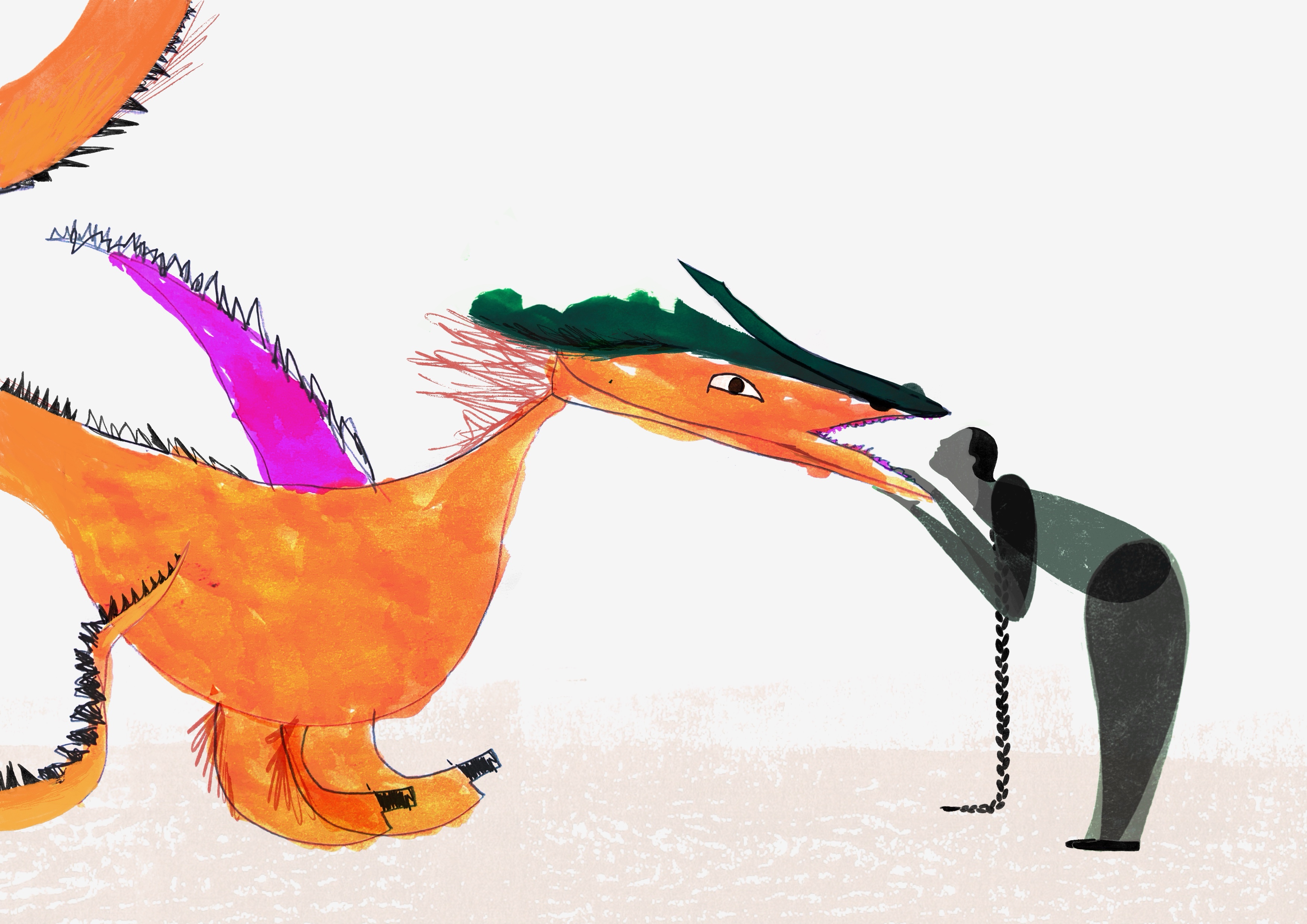
Here be dragons. Moving beyond can be scary as most of us have barely accepted, or are still struggling to accept that chaos is the point of what the agents of our cannibalistic systems are unleashing on us. It is also a phase in a broader historical cycle.
What these forces of evil seek is only destruction: of our governments, our institutions, our democracies, our values, our energies, our attention, our relationships with each other.
Our task should therefore not be to plead with them; we must give up pushing into the centre. Instead, we must turn to the margins and push outwards. We should give in to a little bit of madness, to the unknown and perhaps dangerous territories.
Where they break apart, we must build. Where they destroy, we must create.
We would be wise to look to other countries and communities where collapse and destruction have been the norm for a long time. Not because we should give up on demanding governments do their jobs, but to admit that seeking reform today is the wrong kind of madness.
Because history also teaches us that when authoritarianism rises, resistance emerges and spreads. But for many people, in particular those in countries where we have been relying on our governments and institutions for everything, these marginal spaces may not exist, or may not feel accessible.
In a conversation between Yara Hawari, Tareq Baconi and Juliano Fiori, they discuss some of the challenges and shortcomings of solidarities in relation to Palestine and connected global struggles, noting that many of us have been de-politicised and do not have an infrastructure to hold our struggles, for our political education, or to build an ideology.
Hawari says that unless all those people going on the marches are also being mobilised into larger political projects, it risks remaining at this sort of shallow social media level of solidarity. “Do people know why they support Palestine, politically?” she asks. “Do people know why they’re against the genocide in Sudan, politically? Okay, we’re against mass slaughter and all that, but it needs to go further.”
Baconi says that anger won’t lead to sustainable change unless it’s folded into a structure. But people are generally not feeling like they are held in their entry into politics because for many, there isn’t that container through which they can express their solidarity, or through which they can express their commitment to a different future.
More and more people are setting off on various journeys to do exactly that, from humanitarian flotillas to journalists starting something new, to sanctuaries where people can escape to practise refusal. But these spaces are still too few, they might not be accessible to newcomers, they are often individualistic in nature, and disconnected from each other.
What we lack in this moment is collective action in order that we can build collective power. This should be our work now: we should build what Václav Havel called the parallel polis.
In The Power of the Powerless, Havel said that rather than escaping reality, we should attempt to create spaces where we reject totalitarianism by living within the truth, where we defend the aims of life, where we defend humanity. This is not an escape or a group solution, he insists, rather “the parallel polis points beyond itself and makes sense only as an act of deepening one's responsibility to and for the whole.”
Those who are too attached to the traditional political way of thinking see these dissident movements as weak because they are only a defensive response, he explains. He sees that as their greatest strength. "The primary purpose of the outward direction of these movements is always, as we have seen, to have an impact on society, not to affect the power structure, at least not directly and immediately.”
These initiatives “address the hidden sphere; they demonstrate that living within the truth is a human and social alternative and they struggle to expand the space available for that life; they help—even though it is, of course, indirect help—to raise the confidence of citizens; they shatter the world of appearances and unmask the real nature of power."
To build this collective power, we must be disciplined, but we must also be kinder to each other. We must see failure as practice. This is why this work requires first and foremost inner work, where we come to terms with - and let go of - the ways in which we have been contributing to, or perpetuating harm, whether directly or indirectly. This requires courage; this is where we need to learn to tame our dragon and harness its power, otherwise, as Ursula Le Guin warned, those “who deny the existence of dragons are often eaten by dragons. From within.”
Whatever form this takes, this is where we can practise other ways of being, of working, of collaborating, based on shared values. Importantly, it will make us better prepared for whatever comes next.
Words, Veronica Yates and illustration, Miriam and Teo Sugranyes
_________________________________
References
‘Alameda Dialogues: Between Palestine and the world: Sovereignty and solidarity after order.’ Featuring Yara Hawari, Tareq Baconi, and Juliano Fiori, Alameda Institute, 29 April 2026. Watch here.
‘The Power of the Powerless,’ Václav Havel, 1978. Download in pdf here.
The Wave in the Mind, Talks and Essays on the Writer, the Reader, and the Imagination, Ursula K. Le Guin., Archive for Research in Archetypal Symbolism, Taschen.
The I Ching (Book of Changes).
Dragon Related Resources
Film: Enter the Dragon: The Deadly Three, 1973.
Song: ‘Taming the Dragon,’ by Brad Mehldau. Listen here.
Books: Earthsee, Ursula K. Le Guin.
Podcast: Enter The Dragon, Terrifying and Beautiful (Part 1), The Emerald Podcast. Listen here.
Further Resources
From the Clinic to the Streets: Psychoanalysis for Revolutionary Futures, Lara Sheehi.
‘Western leaders play their part in our charade democracies. Can you spot the tell?’ Jonathan Cook, 20 May 2026. Read here.
‘Why Capitalism Can’t Save Us | Jason Hickel on Climate, AI & Empire (Better Future 003).’ Michael Mezzatesta, 31 Jul 2025. Watch here.
Pedagogy of the Oppressed, Paulo Freire.
Freedom is a Constant Struggle, Angela Davis.
Escape from Freedom, Erich Fromm.,
A Book about the Way and the Power of the Way, A new English version by Ursula K. Le Guin.

“Politics is the art of looking for trouble, finding it everywhere, diagnosing it incorrectly and applying the wrong remedies.” — Groucho Marx


“Either way, change will come. It could be bloody, or it could be beautiful. It depends on us.” ― Arundhati Roy

“We must recognise and nurture the creative parts of each other without always understanding what will be created.”― Audre Lorde

“When you see people call themselves revolutionary, always talking about destroying, destroying, destroying but never talking about building or creating, they're not revolutionary. They do not understand the first thing about revolution. It's creating.” — Kwame Ture

“It is often safer to be in chains than to be free.” — Franz Kafka


