
By clicking “Accept All Cookies”, you agree to the storing of cookies on your device to enhance site navigation, analyze site usage, and assist in our marketing efforts. View our Privacy Policy for more information.
“There is a painting by Klee called Angelus Novus. An angel is depicted there who looks as though he were about to distance himself from something which he is staring at. His eyes are opened wide, his mouth stands open and his wings are outstretched. The Angel of History must look just so.” — Walter Benjamin


Paris, July 1830, as confrontations between the military and revolutionaries spilled into the streets, workers began shooting at city clocks as these came to symbolise the march of progress, progress which they understood only benefited the ruling elites.
Can time be resisted? History is usually told in a linear way, where we flow through time towards progress. Walter Benjamin rejected this concept of history written as a linear narrative of victories; when leaders speak of progress or advancements, he insisted, the question we should be asking is: at whose expense?
In his 1940 essay On the Concept of History* Benjamin describes the image of the ‘Angel of History’ which is being blown backward into the future by the storm of progress, while staring in horror at the accumulating wreckage of the past. Benjamin argued that rather than moving towards a better world, we are in fact being blindly swept away while destruction accumulates.
Indeed wherever we look, a growing number of leaders, from politicians to tech oligarchs, are asking us not to look at the heap of debris, at the bodies piling up. They want us to believe that whatever horror or pain befalls humans, it is just a storm, a temporary but necessary phase we must pass through in order for progress to be made real.
Benjamin insisted that to truly understand the concept of history, we should look to the oppressed because "[t]he tradition of the oppressed teaches us that the 'state of emergency' in which we live is not the exception but the rule.” Peace is the exception, and not seeing that is a failure of imagination.
Is there perhaps another way to understand time? Time as we know it: from working hours, to ceasefires, to countdowns (including ‘we have two years to save the planet’), are western and colonial tools.
Potawatomi philosopher Kyle Powys Whyte says by presuming there is urgency, you can impose swift action, even at the cost of sacrificing morals or ethics. “People who perpetrate colonialism often imagine that their wrongful actions are defensible because they are responding to some crisis,” he writes.
In many Indigenous worldviews, the acceleration or linearity of western time is seen as a kind of sickness or dislocation.
The Andean cosmology, for example, has the concept of ‘pacha', where the past, including ancestors, history, and memory are in front of us, and the future, the unknown, is behind us. Aboriginal Australians have the concept of Everywhen, which does not separate past, present, and future; they exist simultaneously. In the Nahua tradition, time was viewed as interlocking cycles of different wavelengths. Time isn't an empty container we move through; it’s a substance that can be heavy or light, dangerous or fertile.
The problem we face is not just one of running out of time in a linear sense, but a fracturing of time as kinship, Whyte says. When time is reduced to a measurable resource, relationships become transactions. But time as a relationship can be healed.
Benjamin says that we must resist and subvert the concept of time that has been imposed on us by a system designed to exhaust us into submission, this is a revolutionary act. We must do this by bringing about a real state of emergency and fight the fascism that is already here.
He proposes his concept of now-time, versus empty time. Empty time tells us this will pass, we can wait out the storm; empty time makes us complicit. Now-time is when the past and the present crash into each other. It calls on us to take action now because the system which is working as designed must be interrupted, we must ‘blast open the continuum.’
Art can be that emergency break, it can make us not turn away, but stand still in the storm, it can force the world to stop and look at the wreckage while it is still unfolding. Art can help us re-weave time, it can help us re-member, as Toni Morrison wrote.
Emerged from Black radical traditions is the concept of fugitive time, imagined alternate temporalities where bodies were free from violence. Fugitive time, according to Fred Moten, is the time stolen by the oppressed to be human in a system that wants them dead or working.
Fugitive time is a form of resistance, it is a space where the countdown is suspended, even for a moment, to give space for kinship, for memory, for witness. For a child in Gaza, fugitive time might be playing, praying, mourning or dancing.
For those of us outside the deathworlds, interrupting time is a moral duty. We must use our privilege of time to hold the space that the bomb is trying to destroy. Now-time asks us to refuse the narrative, to stop doom-scrolling, to pull the emergency break. It is not a retreat from the world, but an insistence on being fully present in it.
Words, Veronica Yates
Angelus Novus, by Paul Klee,
See also: Resisting Erasure / The Artist as Historian / The Brokers of Violence
______________________
‘Theses on the Philosophy of History,’ (also called ‘On the Concept of History’), Walter Benjamin, written in 1940 and published posthumously in 1942. Read here. (see extract below)
‘Against Crisis Epistemology,’ Whyte, K. 2021. Handbook of Critical Indigenous Studies. Edited b, A. Moreton-Robinson, L. Tuhiwai-Smith, C. Andersen, and S. Larkin, 52-64. Routledge.
Aztec thought and culture; a study of the ancient Nahuatl mind, León Portilla, Miguel.
‘Theorizing Relations in Indigenous South America,’ by Marcelo González Gálvez, Piergiorgio Di Giminiani, and Giovanna Bacchiddu, Berghahn Journals. Read here.
The Undercommons: Fugitive Planning & Black Study, Stefano Harney and Fred Moten.
Fugitive time: global aesthetics and the black beyond, Matthew Omelsky.
‘A Country of Words: Mapping Memory, Resistance, and Exile in Palestinian Literary History,’ Walid el Houri and Refqa Abu-Remaileh, UntoldMag, October 14, 2025. Read here.
Fugitive Feminism, Akwugo Emejulu.
‘The Meaning of Time in the Moral World,’ Walter Benjamin.
‘Poetic Narratives of Black Fugitivity w/Fred Moten,’ Boston Ujima Project, 25 April 2024, watch here.
The Serviceberry: An Economy of Abundance, Robin Wall Kimmerer.
The Shock Doctrine: The Rise of Disaster Capitalism, Naomi Klein.
One Day, Everyone Will Have Always Been Against This, Omar El Akkad.
Momo, also known as The Grey Gentlemen, or The Men in Grey, Michael Ende.
One Hundred Years of Solitude, Gabriel García Márquez.
.jpg)
“Nature does not hurry, yet everything is accomplished.” – Lao Tzu

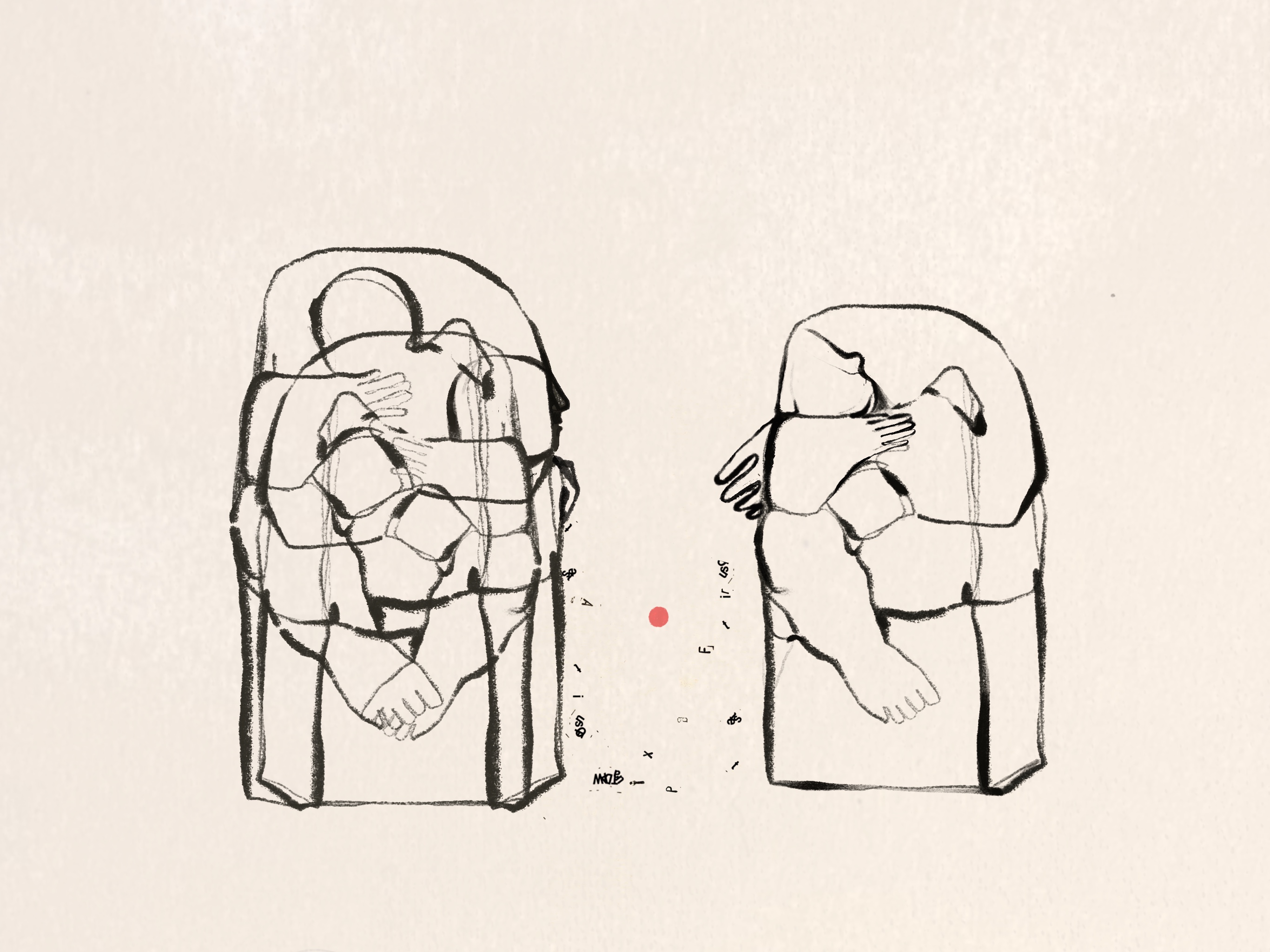
“I have seen that it is not man that is impotent in the struggles against evil, but the power of evil that is impotent in the struggle against man. The powerlessness of kindness, of senseless kindness, is the secret of its immortality.… Human history is not man’s battle to overcome evil. It is a battle fought by a great evil struggling to crush a small kernel of human kindness. But if what is human in human beings has not been destroyed even now, then evil will never conquer.” — Vasily Grossman


