
By clicking “Accept All Cookies”, you agree to the storing of cookies on your device to enhance site navigation, analyze site usage, and assist in our marketing efforts. View our Privacy Policy for more information.
“People get used to anything. The less you think about your oppression, the more your tolerance for it grows. After a while, people just think oppression is the normal state of things. But to become free, you have to be acutely aware of being a slave.” ― Assata Shakur



Much has been written and is being debated about why people choose authoritarian leaders or parties. Reasons given in popular discourse are usually overly simplistic. This means our responses are also too simplistic and mostly futile, like going to a demonstration to declare we are not them, or trying to ban extreme parties from standing in elections.
While much of our attention is focused on those we are not, we omit to look at the quiet majority, (those of us) who might be appalled by the extreme, but remain bystanders. For it is not the violent hateful minority who enable fascism to take root, but the acquiescent majority who convince themselves they are good people.
In our short-term and catastrophe-minded view of history, we imagine that fascism will arrive loudly and visibly, with drums, boots and swastikas. But fascism is not a one time event. It arrives quietly, slowly, meticulously, through bureaucratic, technological, and infrastructural means. It might even do so while preaching values of equality, neutrality, meritocracy, integration, or citizenship. Politely.
To understand how we may have become so comfortably numb, we turn yet again to Frantz Fanon whose psychiatric insights within French colonisation of Algeria showed how institutional neutrality becomes complicity. We draw parallels not to equate bystanders with colonised people but because strategies of domination employ the same methods, whether in the colonies or in the imperial core, and because as Aimé Césaire said, fascism is colonialism turned inwards.
The way colonialism works is by enlisting enough people among the colonised to do their work for them. His case studies reveal how the colonial system itself is a fertile purveyor for psychiatric hospitals, where it seeks to dominate people through the "sum total of harmful nervous stimuli" that overwhelm defensive attitudes. Fanon observed how this produced collective pathology.
Through a Fanonian analysis of our present times, Achille Mbembe explains that fascism is not an aberration but a continuity of liberal colonial modernity. Neutrality is what enables fascism.
For Mbembe, fascism manifests itself in three ways. First, through what he calls nanoracism, the banal, everyday prejudice. “Nanoracism is racism turned culture, a kind of all-pervading breath in its banality and capacity to infiltrate into the very pores and veins of society at a time of generalised brainwashing, automated stupidity and mass stupor,“ he writes.
The second is through necropolitical bureaucracy, or institutional death-making. This is when the state suspends certain laws (or enact new ones) that harm specific groups of people, undesirables, those who try to resist the state, or because they are rendered superfluous. Increasingly, this bureaucracy will be implemented through the help of technology, thereby removing the human from decisions. The algorithms decide who gets healthcare, who gets food, who must be removed, who must die.
And finally, we have the obsessive need for enemies, what he calls manufactured enmity, all while swearing neutrality. Liberal democracies, he explains, have always constituted "communities of kindred folk, societies of separation based on identity and on an exclusion of difference,” which have "always had slaves, a set of people who, for whatever reason, are regarded as foreigners, members of a surplus population, undesirables whom one hopes to be rid of." This need for enemies becomes what he refers to as the phantasy of annihilation, of purification, which would allow for a new beginning, another history, without these unwanted people.
One of the premises on which our so-called western democracies are built (we have been brainwashed to believe) is that we are civilised people who build civilised institutions that care about the world and want what is best for people and planet. But the performance of civility is not civility. Preaching civility is not the practice of civility.
As the masks begin to fall, many of us are left paralysed. We want to absolve ourselves of responsibility. Maybe we can still reform ourselves out of this. If not, we can seek inner peace. Give money to charity. This way of thinking comes in part from our inability to imagine another system than the one we are part of, that we benefit from, that we might have contributed to building. And every once in a while, the system will give us a few wins to keep us hopeful, to keep us in line, to keep us from planning the revolution.
So we must find courage (which comes from the word coeur, which means heart), because at this stage, to still believe in freedom, to be able to imagine justice for all people, requires heart. Maybe a bit of madness too. It certainly asks us, first and foremost, to stop just carrying on. To stop following the rules, to stop conforming. To let go. To reach outwards.
From there, as Arundhati Roy said: “I don't have the Big Idea. I don't have the arrogance to even want to have the Big Idea. But I believe the physics of resisting power is as old as the physics of accumulating power. That's what keeps the balance in the universe... the refusal to obey.”
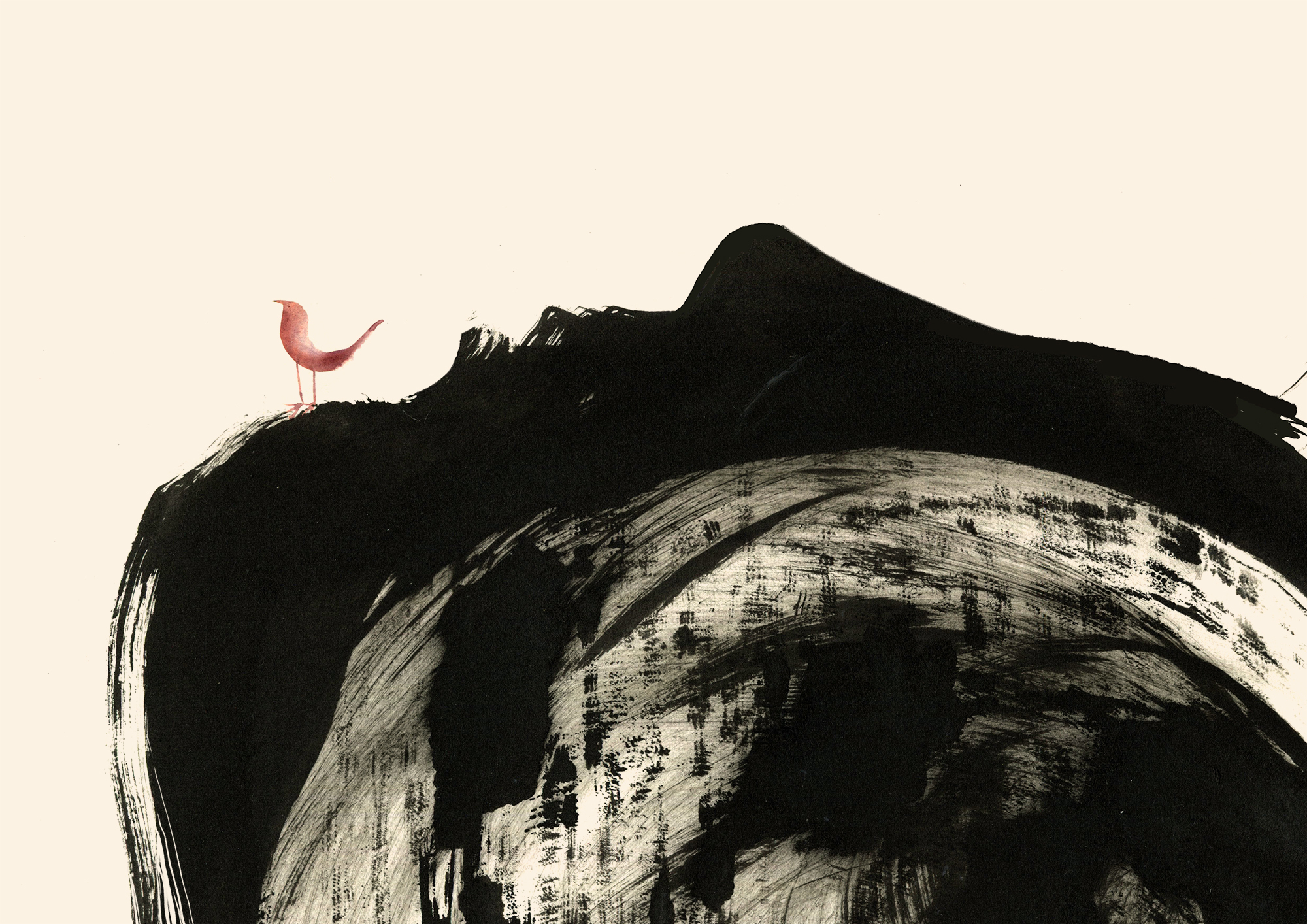
Words, Veronica Yates and illustration, Miriam Sugranyes
___________________
References
The Wretched of the Earth, Frantz Fanon.
‘The Society of Enmity,’ Achille Mbembe, Radical Philosophy. Read here.
Necropolitics, Achille Mbembe.
‘Comfortably Numb Reimagined’ Roger Waters with & Mona Miari, June 2026, Listen & watch here.
‘Things That Can and Cannot Be Said,’ By Arundhati Roy & John Cusack, Truth Out, 16 November, 2015. Read here.
‘The Burden of Freedom,’ The Rights Studio Journal, read here.
Further Resources
Bystanders No More, visit: https://bystandersnomore.org/
How to Survive the End of the World, Podcast by Autumn Brown and adrienne maree brown. Listen here: https://endoftheworldshow.org/
‘The rise of end times fascism,’ Naomi Klein and Astra Taylor, The Guardian, 13 April 2025. Read here.
‘The Last of the Free People,’ by Soheil Malagutti, 6 July 2026. Read here.
‘AI: the New Aesthetics of Fascism,’ by Gareth Watkins, The European Alternatives Journal, Issue 13, 9 July 2026. Read here.
Escape from Freedom, Erich Fromm.

"Alice laughed: "There's no use trying," she said; "one can't believe impossible things." "I daresay you haven't had much practice," said the Queen. "When I was younger, I always did it for half an hour a day. Why, sometimes I've believed as many as six impossible things before breakfast." — Alice in Wonderland

“Hell is empty and all the devils are here.” — William Shakespeare, The Tempest “Here is a river flowing now very fast. It is so great and swift that there are those who will be afraid, who will try to hold on to the shore. They are being torn apart and will suffer greatly.” — From the Elders of the Hopi Nation

“Every single empire in its official discourse has said that it is not like all the others, that its circumstances are special, that it has a mission to enlighten, civilise, bring order and democracy, and that it uses force only as a last resort. And, sadder still, there always is a chorus of willing intellectuals to say calming words about benign or altruistic empires, as if one shouldn't trust the evidence of one's eyes watching the destruction and the misery and death brought by the latest mission civilisatrice.” ― Edward W. Said

“Disobedience, in the eyes of any one who has read history, is man’s original virtue. It is through disobedience that progress has been made, through disobedience and through rebellion.” — Oscar Wilde

“Life shrinks or expands in proportion to one’s courage.” — Anais Nin


